2000s Game Night
2000s Game Night
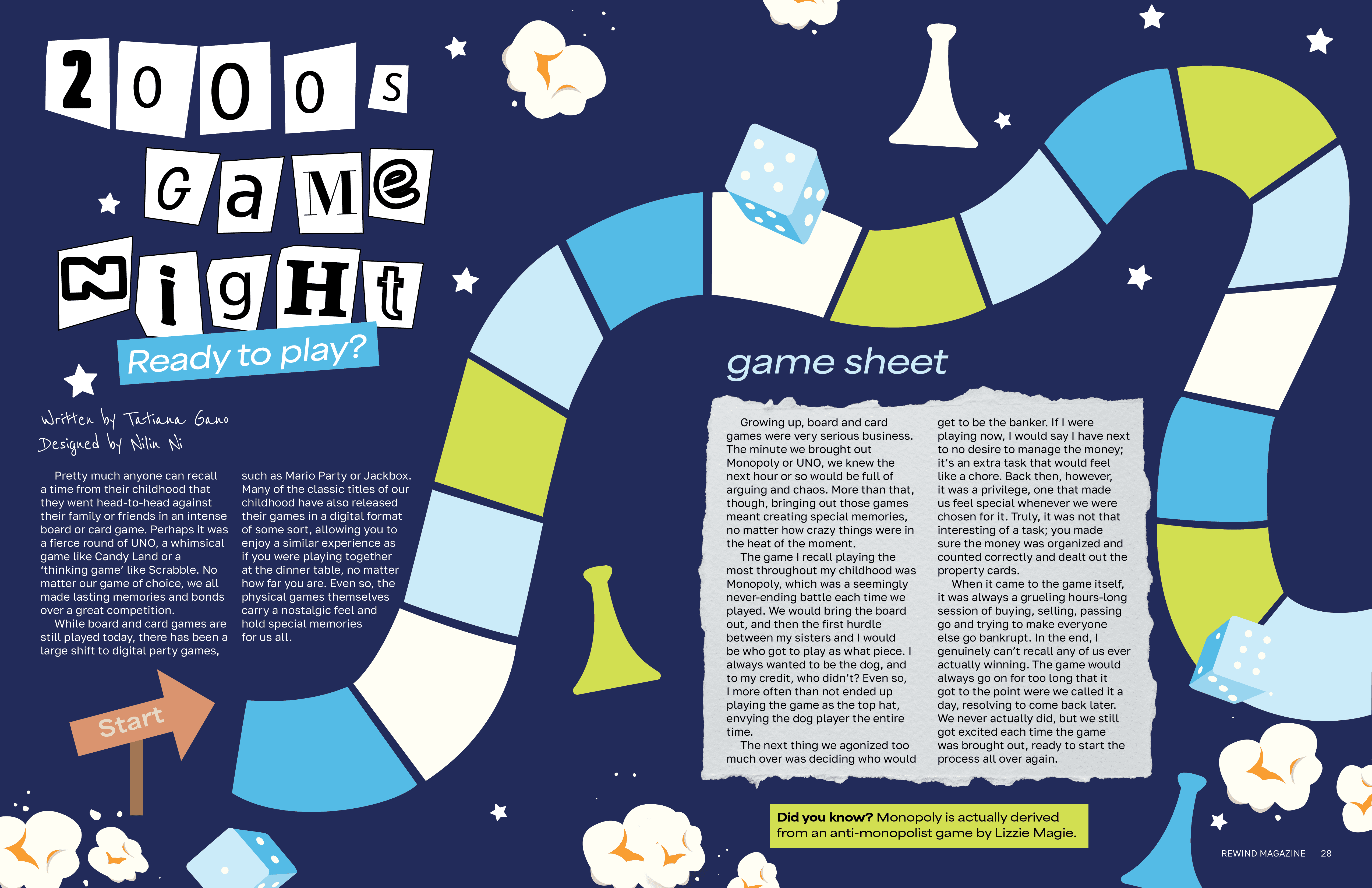
Pretty much anyone can recall a time from their childhood that they went head-to-head against their family or friends in an intense board or card game. Perhaps it was a fierce round of UNO, a whimsical game like Candy Land or a ‘thinking game’ like Scrabble. No matter our game of choice, we all made lasting memories and bonds over a great competition.
While board and card games are still played today, there has been a large shift to digital party games, such as Mario Party or Jackbox. Many of the classic titles of our childhood have also released their games in a digital format of some sort, allowing you to enjoy a similar experience as if you were playing together at the dinner table, no matter how far you are. Even so, the physical games themselves carry a nostalgic feel and hold special memories for us all.
Game Sheet
Growing up, board and card games were very serious business. The minute we brought out Monopoly or UNO, we knew the next hour or so would be full of arguing and chaos. More than that, though, bringing out those games meant creating special memories, no matter how crazy things were in the heat of the moment.
The game I recall playing the most throughout my childhood was Monopoly, which was a seemingly never-ending battle each time we played. We would bring the board out, and then the first hurdle between my sisters and I would be who got to play as what piece. I always wanted to be the dog, and to my credit, who didn’t? Even so, I more often than not ended up playing the game as the top hat, envying the dog player the entire time.
The next thing we agonized too much over was deciding who would get to be the banker. If I were playing now, I would say I have next to no desire to manage the money; it’s an extra task that would feel like a chore. Back then, however, it was a privilege, one that made us feel special whenever we were chosen for it. Truly, it was not that interesting of a task; you made sure the money was organized and counted correctly and dealt out the property cards.
When it came to the game itself, it was always a grueling hours-long session of buying, selling, passing go and trying to make everyone else go bankrupt. In the end, I genuinely can’t recall any of us ever actually winning. The game would always go on for too long that it got to the point were we called it a day, resolving to come back later. We never actually did, but we still got excited each time the game was brought out, ready to start the process all over again.
Candy Land
A popular game for young kids, Candy Land requires minimal skills to navigate the game and claim victory. The directions are super simple; players draw a card from the top of the deck, or use the spinner in later versions showing a colored square or two that guides the player which space to go to. One square means to go to the next space of that color, and two squares mean to go to the second next space.
Players can also draw the option to go directly to a certain location on the map if that card is drawn. Simply, each player keeps moving their pieces until they either land on or pass the last square at the Candy Castle. The lost King Kandy is then saved in the game’s storyline, thanks to the winner!
Monopoly
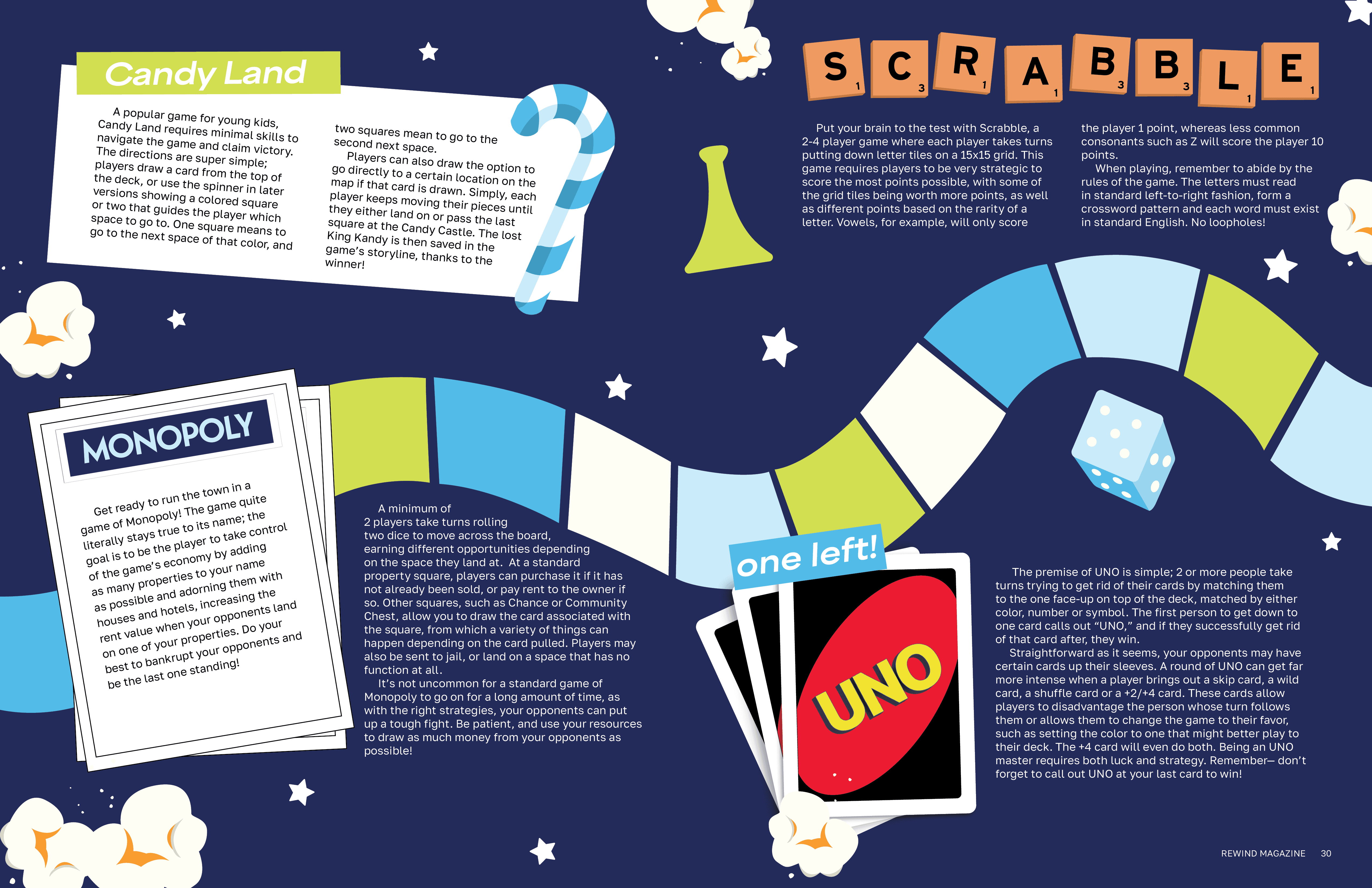
Get ready to run the town in a game of Monopoly! The game quite literally stays true to its name; the goal is to be the player to take control of the game’s economy by adding as many properties to your name as possible and adorning them with houses and hotels, increasing the rent value when your opponents land on one of your properties. Do your best to bankrupt your opponents and be the last one standing!
A minimum of 2 players take turns rolling two dice to move across the board, earning different opportunities depending on the space they land at. At a standard property square, players can purchase it if it has not already been sold, or pay rent to the owner if so. Other squares, such as Chance or Community Chest, allow you to draw the card associated with the square, from which a variety of things can happen depending on the card pulled. Players may also be sent to jail, or land on a space that has no function at all. It’s not uncommon for a standard game of Monopoly to go on for a long amount of time, as with the right strategies, your opponents can put up a tough fight. Be patient, and use your resources to draw as much money from your opponents as possible!
Scrabble
Put your brain to the test with Scrabble, a 2-4 player game where each player takes turns putting down letter tiles on a 15x15 grid. This game requires players to be very strategic to score the most points possible, with some of the grid tiles being worth more points, as well as different points based on the rarity of a letter. Vowels, for example, will only score the player 1 point, whereas less common consonants such as Z will score the player 10 points. When playing, remember to abide by the rules of the game. The letters must read in standard left-to-right fashion, form a crossword pattern and each word must exist in standard English. No loopholes!
One Left!
The premise of UNO is simple; 2 or more people take turns trying to get rid of their cards by matching them to the one face-up on top of the deck, matched by either color, number or symbol. The first person to get down to one card calls out “UNO,” and if they successfully get rid of that card after, they win. Straightforward as it seems, your opponents may have certain cards up their sleeves. A round of UNO can get far more intense when a player brings out a skip card, a wild card, a shuffle card or a +2/+4 card. These cards allow players to disadvantage the person whose turn follows them or allows them to change the game to their favor, such as setting the color to one that might better play to their deck. The +4 card will even do both. Being an UNO master requires both luck and strategy. Remember— don’t forget to call out UNO at your last card to win!
Pretty much anyone can recall a time from their childhood that they went head-to-head against their family or friends in an intense board or card game. Perhaps it was a fierce round of UNO, a whimsical game like Candy Land or a ‘thinking game’ like Scrabble. No matter our game of choice, we all made lasting memories and bonds over a great competition.
While board and card games are still played today, there has been a large shift to digital party games, such as Mario Party or Jackbox. Many of the classic titles of our childhood have also released their games in a digital format of some sort, allowing you to enjoy a similar experience as if you were playing together at the dinner table, no matter how far you are. Even so, the physical games themselves carry a nostalgic feel and hold special memories for us all.
Game Sheet
Growing up, board and card games were very serious business. The minute we brought out Monopoly or UNO, we knew the next hour or so would be full of arguing and chaos. More than that, though, bringing out those games meant creating special memories, no matter how crazy things were in the heat of the moment.
The game I recall playing the most throughout my childhood was Monopoly, which was a seemingly never-ending battle each time we played. We would bring the board out, and then the first hurdle between my sisters and I would be who got to play as what piece. I always wanted to be the dog, and to my credit, who didn’t? Even so, I more often than not ended up playing the game as the top hat, envying the dog player the entire time.
The next thing we agonized too much over was deciding who would get to be the banker. If I were playing now, I would say I have next to no desire to manage the money; it’s an extra task that would feel like a chore. Back then, however, it was a privilege, one that made us feel special whenever we were chosen for it. Truly, it was not that interesting of a task; you made sure the money was organized and counted correctly and dealt out the property cards.
When it came to the game itself, it was always a grueling hours-long session of buying, selling, passing go and trying to make everyone else go bankrupt. In the end, I genuinely can’t recall any of us ever actually winning. The game would always go on for too long that it got to the point were we called it a day, resolving to come back later. We never actually did, but we still got excited each time the game was brought out, ready to start the process all over again.
Candy Land
A popular game for young kids, Candy Land requires minimal skills to navigate the game and claim victory. The directions are super simple; players draw a card from the top of the deck, or use the spinner in later versions showing a colored square or two that guides the player which space to go to. One square means to go to the next space of that color, and two squares mean to go to the second next space.
Players can also draw the option to go directly to a certain location on the map if that card is drawn. Simply, each player keeps moving their pieces until they either land on or pass the last square at the Candy Castle. The lost King Kandy is then saved in the game’s storyline, thanks to the winner!
Monopoly
Get ready to run the town in a game of Monopoly! The game quite literally stays true to its name; the goal is to be the player to take control of the game’s economy by adding as many properties to your name as possible and adorning them with houses and hotels, increasing the rent value when your opponents land on one of your properties. Do your best to bankrupt your opponents and be the last one standing!
A minimum of 2 players take turns rolling two dice to move across the board, earning different opportunities depending on the space they land at. At a standard property square, players can purchase it if it has not already been sold, or pay rent to the owner if so. Other squares, such as Chance or Community Chest, allow you to draw the card associated with the square, from which a variety of things can happen depending on the card pulled. Players may also be sent to jail, or land on a space that has no function at all. It’s not uncommon for a standard game of Monopoly to go on for a long amount of time, as with the right strategies, your opponents can put up a tough fight. Be patient, and use your resources to draw as much money from your opponents as possible!
Scrabble
Put your brain to the test with Scrabble, a 2-4 player game where each player takes turns putting down letter tiles on a 15x15 grid. This game requires players to be very strategic to score the most points possible, with some of the grid tiles being worth more points, as well as different points based on the rarity of a letter. Vowels, for example, will only score the player 1 point, whereas less common consonants such as Z will score the player 10 points. When playing, remember to abide by the rules of the game. The letters must read in standard left-to-right fashion, form a crossword pattern and each word must exist in standard English. No loopholes!
One Left!
The premise of UNO is simple; 2 or more people take turns trying to get rid of their cards by matching them to the one face-up on top of the deck, matched by either color, number or symbol. The first person to get down to one card calls out “UNO,” and if they successfully get rid of that card after, they win. Straightforward as it seems, your opponents may have certain cards up their sleeves. A round of UNO can get far more intense when a player brings out a skip card, a wild card, a shuffle card or a +2/+4 card. These cards allow players to disadvantage the person whose turn follows them or allows them to change the game to their favor, such as setting the color to one that might better play to their deck. The +4 card will even do both. Being an UNO master requires both luck and strategy. Remember— don’t forget to call out UNO at your last card to win!