All Dolled Up
All Dolled Up
A Love Letter To The Toy Aisles Of The 2000s
The year is 2012. My sister and I are nine and seven, respectively, and we’re arguing, again, over the correct way to play dolls. While I’m running a horse rescue with our collection of Barbie unicorns and pegasi, my sister is staging an emotional drama worthy of prime-time television. Her Barbie, a Ro doll from “Barbie as the Island Princess,” is going through her second divorce. Her husband, no longer useful, has been sent to what we call The Pit: a Bratz-themed laundry hamper where Barbies go to die.
Eventually, we get so fed up with each other’s respective storylines that we both storm off in protest, swearing we’ll never play together again. And, of course, the next morning, we’re back in the playroom, dividing up dolls between us, deciding what today’s storyline will be.
For us, and millions of other kids in the 2000s, dolls were never just toys. They were co-stars, confidantes and conduits for imagination. They were how we tested out the world before we ever had to live in it.
Back then, we didn’t think much about the dolls themselves. They were simply props in our storytelling. But dolls have always reflected the societies that create them, shaped by the world we were growing up in, and, in their own small way, shaping us right back.
Dolls have long been mirrors of society’s ideals and insecurities. Long before the 2000s, they were already shaping the way children imagined adulthood. The porcelain dolls of the 19th century reflected Victorian femininity, graceful and decorative, while Mid-century paper dolls captured post-war domesticity. And when Barbie appeared in 1959, she redefined play entirely: girls could now project themselves into endless futures depending on the outfit of the day.
But as society evolved, so did our dolls. By the early 2000s, the toy aisle had become a reflection of the cultural changes of the time. Technology was booming, MTV dominated pop culture and the internet was beginning to shape how kids perceived themselves. Dolls became louder, edgier and more self-aware.
Intentionally or not, our dolls taught lessons about beauty, friendship and self-expression. Whether it was the quiet idealism of American Girl or the hyperstylized rebellion of Bratz, each brand told girls something different about who they could be and who they were supposed to be.
Inside The Doll House
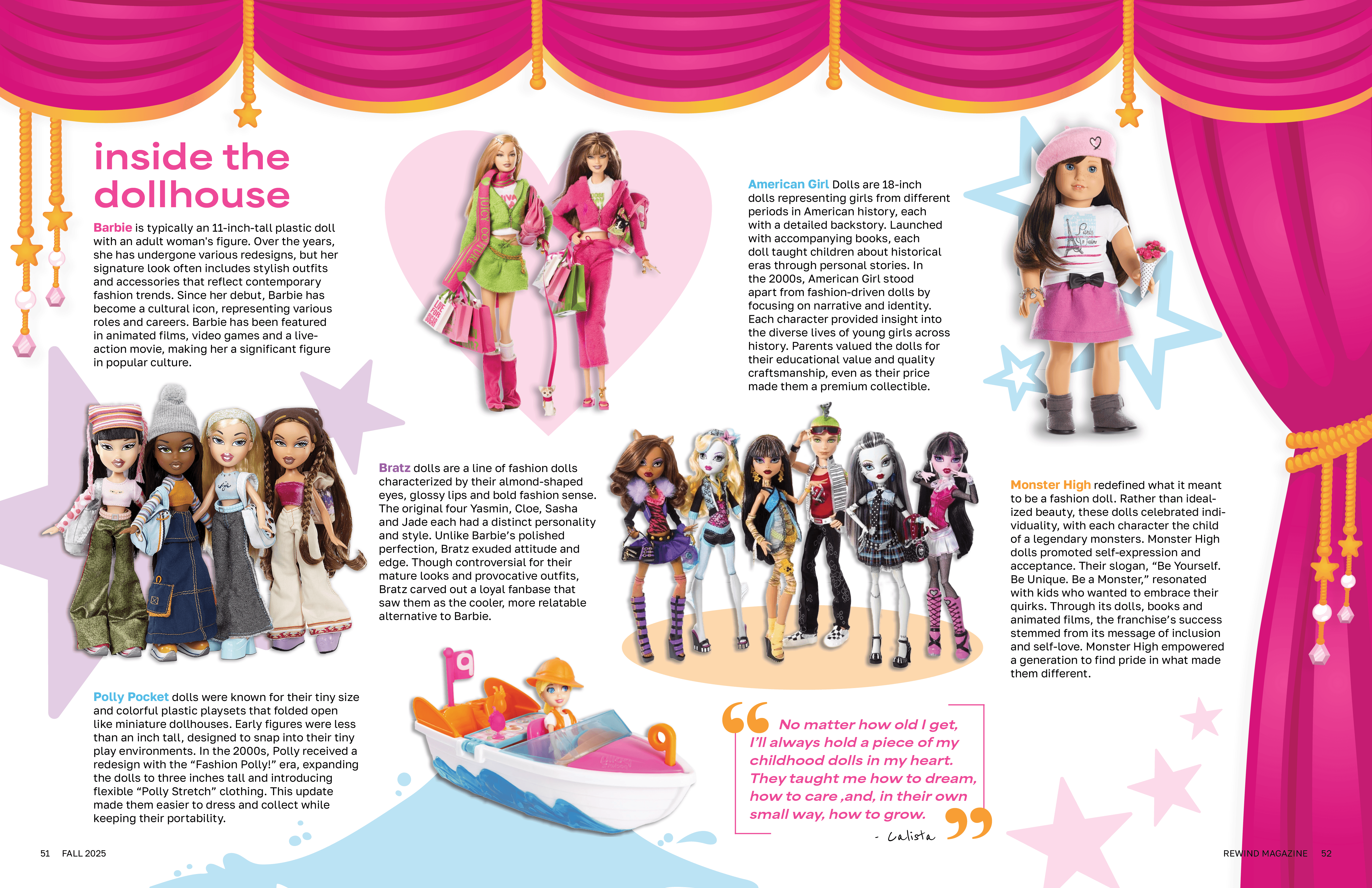
Barbie is typically an 11-inch-tall plastic doll with an adult woman's figure. Over the years, she has undergone various redesigns, but her signature look often includes stylish outfits and accessories that reflect contemporary fashion trends. Since her debut, Barbie has become a cultural icon, representing various roles and careers. Barbie has been featured in animated films, video games and a liveaction movie, making her a significant figure in popular culture.
Bratz dolls are a line of fashion dolls characterized by their almond-shaped eyes, glossy lips and bold fashion sense. The original four Yasmin, Cloe, Sasha and Jade each had a distinct personality and style. Unlike Barbie’s polished perfection, Bratz exuded attitude and edge. Though controversial for their mature looks and provocative outfits, Bratz carved out a loyal fanbase that saw them as the cooler, more relatable alternative to Barbie.
Polly Pocket dolls were known for their tiny size and colorful plastic playsets that folded open like miniature dollhouses. Early figures were less than an inch tall, designed to snap into their tiny play environments. In the 2000s, Polly received a redesign with the “Fashion Polly!” era, expanding the dolls to three inches tall and introducing flexible “Polly Stretch” clothing. This update made them easier to dress and collect while keeping their portability.
American Girl Dolls are 18-inch dolls representing girls from different periods in American history, each with a detailed backstory. Launched with accompanying books, each doll taught children about historical eras through personal stories. In the 2000s, American Girl stood apart from fashion-driven dolls by focusing on narrative and identity. Each character provided insight into the diverse lives of young girls across history. Parents valued the dolls for their educational value and quality craftsmanship, even as their price made them a premium collectible.
Monster High redefined what it meant to be a fashion doll. Rather than idealized beauty, these dolls celebrated individuality, with each character the child of a legendary monsters. Monster High dolls promoted self-expression and acceptance. Their slogan, “Be Yourself. Be Unique. Be a Monster,” resonated with kids who wanted to embrace their quirks. Through its dolls, books and animated films, the franchise’s success stemmed from its message of inclusion and self-love. Monster High empowered a generation to find pride in what made them different.
A Love Letter To The Toy Aisles Of The 2000s
The year is 2012. My sister and I are nine and seven, respectively, and we’re arguing, again, over the correct way to play dolls. While I’m running a horse rescue with our collection of Barbie unicorns and pegasi, my sister is staging an emotional drama worthy of prime-time television. Her Barbie, a Ro doll from “Barbie as the Island Princess,” is going through her second divorce. Her husband, no longer useful, has been sent to what we call The Pit: a Bratz-themed laundry hamper where Barbies go to die.
Eventually, we get so fed up with each other’s respective storylines that we both storm off in protest, swearing we’ll never play together again. And, of course, the next morning, we’re back in the playroom, dividing up dolls between us, deciding what today’s storyline will be.
For us, and millions of other kids in the 2000s, dolls were never just toys. They were co-stars, confidantes and conduits for imagination. They were how we tested out the world before we ever had to live in it.
Back then, we didn’t think much about the dolls themselves. They were simply props in our storytelling. But dolls have always reflected the societies that create them, shaped by the world we were growing up in, and, in their own small way, shaping us right back.
Dolls have long been mirrors of society’s ideals and insecurities. Long before the 2000s, they were already shaping the way children imagined adulthood. The porcelain dolls of the 19th century reflected Victorian femininity, graceful and decorative, while Mid-century paper dolls captured post-war domesticity. And when Barbie appeared in 1959, she redefined play entirely: girls could now project themselves into endless futures depending on the outfit of the day.
But as society evolved, so did our dolls. By the early 2000s, the toy aisle had become a reflection of the cultural changes of the time. Technology was booming, MTV dominated pop culture and the internet was beginning to shape how kids perceived themselves. Dolls became louder, edgier and more self-aware.
Intentionally or not, our dolls taught lessons about beauty, friendship and self-expression. Whether it was the quiet idealism of American Girl or the hyperstylized rebellion of Bratz, each brand told girls something different about who they could be and who they were supposed to be.
Inside The Doll House
Barbie is typically an 11-inch-tall plastic doll with an adult woman's figure. Over the years, she has undergone various redesigns, but her signature look often includes stylish outfits and accessories that reflect contemporary fashion trends. Since her debut, Barbie has become a cultural icon, representing various roles and careers. Barbie has been featured in animated films, video games and a liveaction movie, making her a significant figure in popular culture.
Bratz dolls are a line of fashion dolls characterized by their almond-shaped eyes, glossy lips and bold fashion sense. The original four Yasmin, Cloe, Sasha and Jade each had a distinct personality and style. Unlike Barbie’s polished perfection, Bratz exuded attitude and edge. Though controversial for their mature looks and provocative outfits, Bratz carved out a loyal fanbase that saw them as the cooler, more relatable alternative to Barbie.
Polly Pocket dolls were known for their tiny size and colorful plastic playsets that folded open like miniature dollhouses. Early figures were less than an inch tall, designed to snap into their tiny play environments. In the 2000s, Polly received a redesign with the “Fashion Polly!” era, expanding the dolls to three inches tall and introducing flexible “Polly Stretch” clothing. This update made them easier to dress and collect while keeping their portability.
American Girl Dolls are 18-inch dolls representing girls from different periods in American history, each with a detailed backstory. Launched with accompanying books, each doll taught children about historical eras through personal stories. In the 2000s, American Girl stood apart from fashion-driven dolls by focusing on narrative and identity. Each character provided insight into the diverse lives of young girls across history. Parents valued the dolls for their educational value and quality craftsmanship, even as their price made them a premium collectible.
Monster High redefined what it meant to be a fashion doll. Rather than idealized beauty, these dolls celebrated individuality, with each character the child of a legendary monsters. Monster High dolls promoted self-expression and acceptance. Their slogan, “Be Yourself. Be Unique. Be a Monster,” resonated with kids who wanted to embrace their quirks. Through its dolls, books and animated films, the franchise’s success stemmed from its message of inclusion and self-love. Monster High empowered a generation to find pride in what made them different.