Virtual Worlds
Virtual Worlds
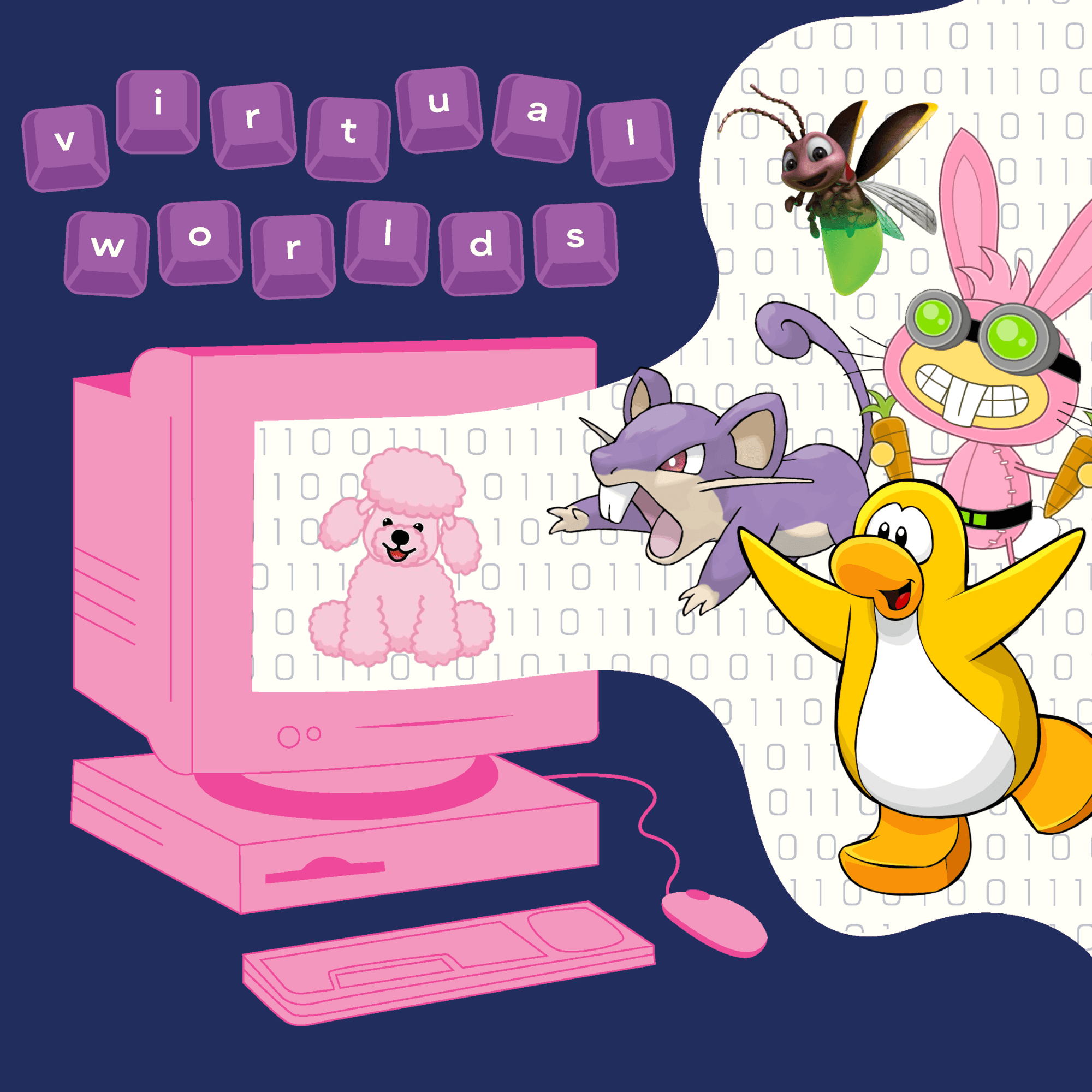
In the 2000s, the internet was more than a place for people to ask questions and look at pictures. For kids, it was an entire universe to play games, connect with others, and explore the boundaries of imagination. From exploring creative new lands to fighting monsters, these Virtual Worlds became a limitless escape for social life, creativity, and identity. Over time, these platforms taught an entire generation and beyond how to exist in digital form, revolutionizing the way we interact online today.
Webkinz
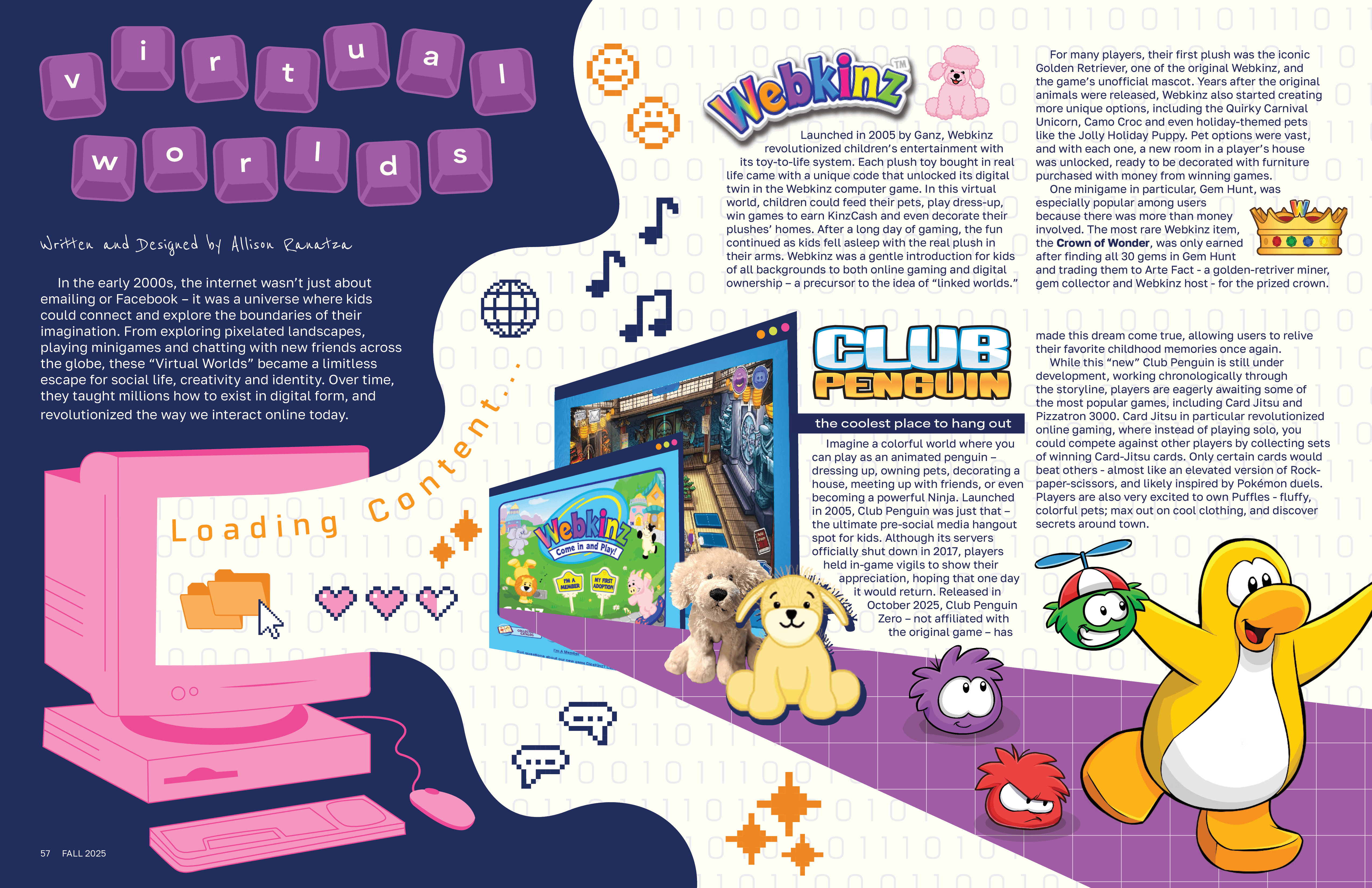
Launched in 2005 by Ganz, Webkinz revolutionized children’s entertainment with its toy-to-life system. Each plush toy bought in real life came with a unique code that unlocked its digital twin in the Webkinz computer game. In this virtual world, children could feed their pets, play dress-up, win games to earn KinzCash, and even decorate their plushes’ homes. After a long day of gaming, the fun continued as kids fell asleep with the real plush in their arms. Webkinz was a gentle introduction for kids of all backgrounds to both online gaming and digital ownership – a precursor to the idea of “linked worlds.”
For many players, their first plush was the iconic Golden Retriever, one of the original Webkinz, and the game’s unofficial mascot. Years after the original animals were released, Webkinz also started creating more unique options, including the Quirky Carnival Unicorn, Camo Croc, and even holiday-themed pets like the Jolly Holiday Puppy. Pet options were vast, and with each one, a new room in a player’s house was unlocked, ready to be decorated with furniture purchased with money from winning games.
One minigame in particular, Gem Hunt, was especially popular among users because there was more than money involved. The most rare Webkinz item, the Crown of Wonder, was only earned after finding all 30 gems in Gem Hunt and trading them to Arte Fact, a gem collector, for the crown.
Club Penguin
The coolest place to hang out
Imagine a colorful world where you can play as an animated penguin: dressing up, owning pets, decorating a house, meeting up with friends, or even becoming a powerful Ninja. Launched in 2005, Club Penguin was just that: the ultimate pre-social media hangout spot for kids. Although its servers officially shut down in 2017, players held in-game vigils to show their appreciation, hoping that one day it would return. Released in October 2025, Club Penguin Zero – not affiliated with the original game – has made this dream come true, allowing users to relive their favorite childhood memories once again.
While this “new” Club Penguin is still under development, working chronologically through the storyline, players are eagerly awaiting some of the most popular games, including Card Jitsu and Pizzatron 3000. Card Jitsu in particular revolutionized online gaming, where instead of playing solo, you could compete against other players by collecting sets of winning Card-Jitsu cards. Only certain cards would beat others - almost like an elevated version of Rock-paper-scissors, and likely inspired by Pokémon duels. Players are also very excited to own Puffles - fluffy, colorful pets; max out on cool clothing, and discover secrets around town.
Pokémon
Pokémon started as a Japanese video game series on the Game Boy with the release of Pocket Monsters Red and Pocket Monsters Green. By collecting the in-game creatures, known as Pokémon, players could battle other Pokémon, take care of them, and “Catch ‘Em All” to become top trainers.
After quickly growing in popularity among Japanese children, the Pokémon games traveled to the U.S. along with trading cards that feature each Pokémon with unique statistics to help users take down opponents. Following the initial trading card release came a 20-season Anime series, featuring a young boy named Ash Ketchum who fights battles and collects Pokémon, hoping to become a top trainer.
Over time, Pokémon has adapted with new consoles, including the Nintendo DS, Nintendo Switch, and eventually iPhones with Pokémon Go, transforming the game into a true virtual world by using players’ real-world location to catch Pokémon and connect with others. With each edition, Pokémon has become a pivotal part of childhood memories from the 90s to today.
Poptropica
In the late 2000s, Poptropica became a defining corner of the internet for kids who loved mystery and exploration. Created in 2007 by the makers of Diary of a Wimpy Kid, the game mirrors the series’ comic book-like art style, humor, and creativity, sending players hopping between themed islands to solve mysteries, puzzles, and meet new characters. From battling Greek Gods and sea monsters to solving a high-speed train whodunit, Poptropica offers an adventure for all types of players.
While Poptropica emphasizes problem-solving and storytelling, players could also have fun outside of the story by collecting costumes and hidden items, customizing their avatars, and learning about history, science, and fiction through educational games disguised as fun.
Pixie Hollow
PixieHollow.com was a world created by Disney under the Disney Fairies brand, where players could design their own Fairy or Sparrow Man and explore the magical world of Pixie Hollow as featured in the Tinker Bell movies. The world composed of hidden treasures, minigames, quests, conversing with other players, and even home decoration, similar to that of Webkinz and Club Penguin.
When creating an avatar, players could not only customize their hair, skin, clothes, and name, but most importantly, choose their fairy talent: Tinker, Water, Garden, Light, or Animal. The Pixie Hollow minigames corresponded to these talents, and by winning, you could earn talent points to raise your overall talent level.
One of the most interesting parts of the game was chatting with other players online. Pixie Hollow was an MMO (a Massively Multiplayer Online game) with thousands of people online on each server at a time. This way, players could get to know each other and compete together in minigames.
While Pixie Hollow shut down in 2013, web developers, such as WeThePixies.net, are currently rewriting the world to experience that childhood nostalgia once more. The only drawback is that, similar to Poptropica, many of the minigames were stored on the now-gone Adobe Flash. Still, the developers are working hard to find new solutions and even create new games for players to enjoy.
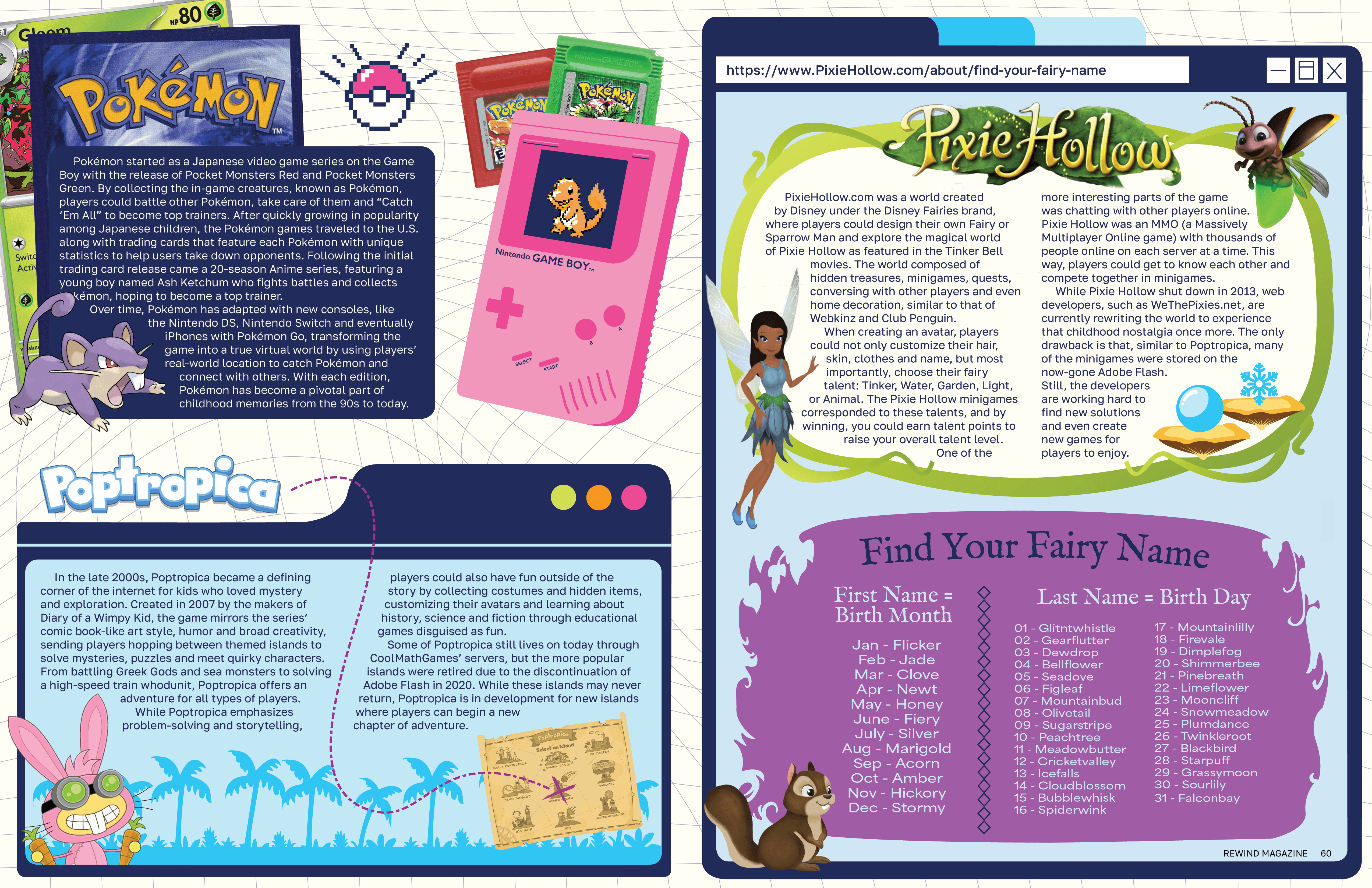
Find Your Fairy Name
Birth Month = First Name
January - Flicker
February - Jade
March - Clove
April - Newt
May - Honey
June - Fiery
July - Silver
August - Marigold
September - Acorn
October - Amber
November - Hickory
December - Stormy
Birth Day = Last Name
01 - Glitntwhistle
02 - Gearflutter
03 - Dewdrop
04 - Bellflower
05 - Seadove
06 - Figleaf
07 - Mountainbud
08 - Olivetail
09 - Sugarstripe
10 - Peachtree
11 - Meadowbutter
12 - Cricketvalley
13 - Icefalls
14 - Cloudblossom
15 - Bubblewhisk
16 - Spiderwink
17 - Mountainlilly
18 - Firevale
19 - Dimplefog
20 - Shimmerbee
21 - Pinebreath
22 - Limeflower
23 - Mooncliff
24 - Snowmeadow
25 - Plumdance
26 - Twinkleroot
27 - Blackbird
28 - Starpuff
29 - Grassymoon
30 - Sourlily
31 - Falconbay
In the 2000s, the internet was more than a place for people to ask questions and look at pictures. For kids, it was an entire universe to play games, connect with others, and explore the boundaries of imagination. From exploring creative new lands to fighting monsters, these Virtual Worlds became a limitless escape for social life, creativity, and identity. Over time, these platforms taught an entire generation and beyond how to exist in digital form, revolutionizing the way we interact online today.
Webkinz
Launched in 2005 by Ganz, Webkinz revolutionized children’s entertainment with its toy-to-life system. Each plush toy bought in real life came with a unique code that unlocked its digital twin in the Webkinz computer game. In this virtual world, children could feed their pets, play dress-up, win games to earn KinzCash, and even decorate their plushes’ homes. After a long day of gaming, the fun continued as kids fell asleep with the real plush in their arms. Webkinz was a gentle introduction for kids of all backgrounds to both online gaming and digital ownership – a precursor to the idea of “linked worlds.”
For many players, their first plush was the iconic Golden Retriever, one of the original Webkinz, and the game’s unofficial mascot. Years after the original animals were released, Webkinz also started creating more unique options, including the Quirky Carnival Unicorn, Camo Croc, and even holiday-themed pets like the Jolly Holiday Puppy. Pet options were vast, and with each one, a new room in a player’s house was unlocked, ready to be decorated with furniture purchased with money from winning games.
One minigame in particular, Gem Hunt, was especially popular among users because there was more than money involved. The most rare Webkinz item, the Crown of Wonder, was only earned after finding all 30 gems in Gem Hunt and trading them to Arte Fact, a gem collector, for the crown.
Club Penguin
The coolest place to hang out
Imagine a colorful world where you can play as an animated penguin: dressing up, owning pets, decorating a house, meeting up with friends, or even becoming a powerful Ninja. Launched in 2005, Club Penguin was just that: the ultimate pre-social media hangout spot for kids. Although its servers officially shut down in 2017, players held in-game vigils to show their appreciation, hoping that one day it would return. Released in October 2025, Club Penguin Zero – not affiliated with the original game – has made this dream come true, allowing users to relive their favorite childhood memories once again.
While this “new” Club Penguin is still under development, working chronologically through the storyline, players are eagerly awaiting some of the most popular games, including Card Jitsu and Pizzatron 3000. Card Jitsu in particular revolutionized online gaming, where instead of playing solo, you could compete against other players by collecting sets of winning Card-Jitsu cards. Only certain cards would beat others - almost like an elevated version of Rock-paper-scissors, and likely inspired by Pokémon duels. Players are also very excited to own Puffles - fluffy, colorful pets; max out on cool clothing, and discover secrets around town.
Pokémon
Pokémon started as a Japanese video game series on the Game Boy with the release of Pocket Monsters Red and Pocket Monsters Green. By collecting the in-game creatures, known as Pokémon, players could battle other Pokémon, take care of them, and “Catch ‘Em All” to become top trainers.
After quickly growing in popularity among Japanese children, the Pokémon games traveled to the U.S. along with trading cards that feature each Pokémon with unique statistics to help users take down opponents. Following the initial trading card release came a 20-season Anime series, featuring a young boy named Ash Ketchum who fights battles and collects Pokémon, hoping to become a top trainer.
Over time, Pokémon has adapted with new consoles, including the Nintendo DS, Nintendo Switch, and eventually iPhones with Pokémon Go, transforming the game into a true virtual world by using players’ real-world location to catch Pokémon and connect with others. With each edition, Pokémon has become a pivotal part of childhood memories from the 90s to today.
Poptropica
In the late 2000s, Poptropica became a defining corner of the internet for kids who loved mystery and exploration. Created in 2007 by the makers of Diary of a Wimpy Kid, the game mirrors the series’ comic book-like art style, humor, and creativity, sending players hopping between themed islands to solve mysteries, puzzles, and meet new characters. From battling Greek Gods and sea monsters to solving a high-speed train whodunit, Poptropica offers an adventure for all types of players.
While Poptropica emphasizes problem-solving and storytelling, players could also have fun outside of the story by collecting costumes and hidden items, customizing their avatars, and learning about history, science, and fiction through educational games disguised as fun.
Pixie Hollow
PixieHollow.com was a world created by Disney under the Disney Fairies brand, where players could design their own Fairy or Sparrow Man and explore the magical world of Pixie Hollow as featured in the Tinker Bell movies. The world composed of hidden treasures, minigames, quests, conversing with other players, and even home decoration, similar to that of Webkinz and Club Penguin.
When creating an avatar, players could not only customize their hair, skin, clothes, and name, but most importantly, choose their fairy talent: Tinker, Water, Garden, Light, or Animal. The Pixie Hollow minigames corresponded to these talents, and by winning, you could earn talent points to raise your overall talent level.
One of the most interesting parts of the game was chatting with other players online. Pixie Hollow was an MMO (a Massively Multiplayer Online game) with thousands of people online on each server at a time. This way, players could get to know each other and compete together in minigames.
While Pixie Hollow shut down in 2013, web developers, such as WeThePixies.net, are currently rewriting the world to experience that childhood nostalgia once more. The only drawback is that, similar to Poptropica, many of the minigames were stored on the now-gone Adobe Flash. Still, the developers are working hard to find new solutions and even create new games for players to enjoy.
Find Your Fairy Name
Birth Month = First Name
January - Flicker
February - Jade
March - Clove
April - Newt
May - Honey
June - Fiery
July - Silver
August - Marigold
September - Acorn
October - Amber
November - Hickory
December - Stormy
Birth Day = Last Name
01 - Glitntwhistle
02 - Gearflutter
03 - Dewdrop
04 - Bellflower
05 - Seadove
06 - Figleaf
07 - Mountainbud
08 - Olivetail
09 - Sugarstripe
10 - Peachtree
11 - Meadowbutter
12 - Cricketvalley
13 - Icefalls
14 - Cloudblossom
15 - Bubblewhisk
16 - Spiderwink
17 - Mountainlilly
18 - Firevale
19 - Dimplefog
20 - Shimmerbee
21 - Pinebreath
22 - Limeflower
23 - Mooncliff
24 - Snowmeadow
25 - Plumdance
26 - Twinkleroot
27 - Blackbird
28 - Starpuff
29 - Grassymoon
30 - Sourlily
31 - Falconbay