“What you wear is how you present yourself to the world, especially today when human contacts go so fast. Fashion is an instant language.” - Miuccia Prada, 2011
The Runway Edit
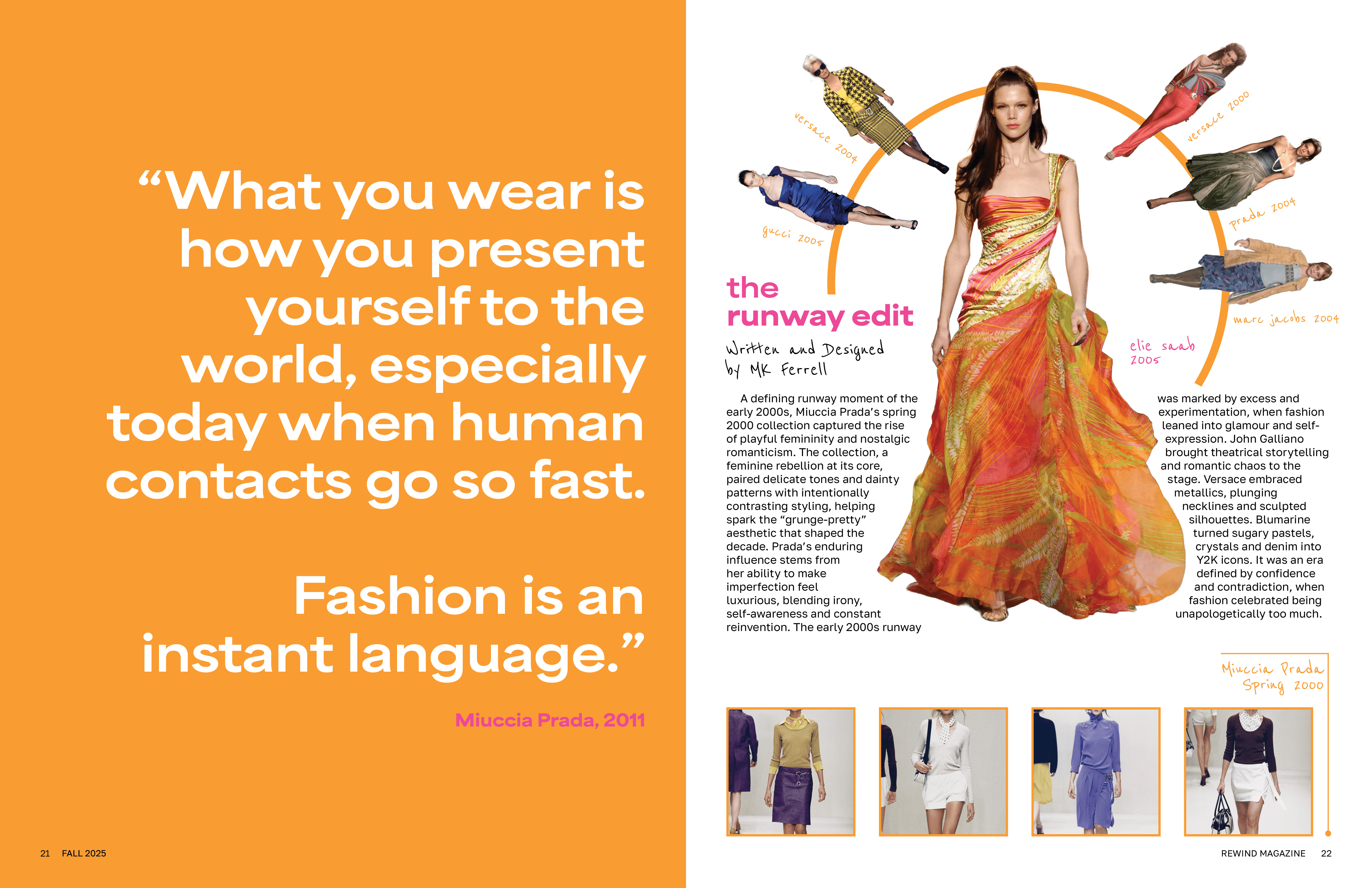
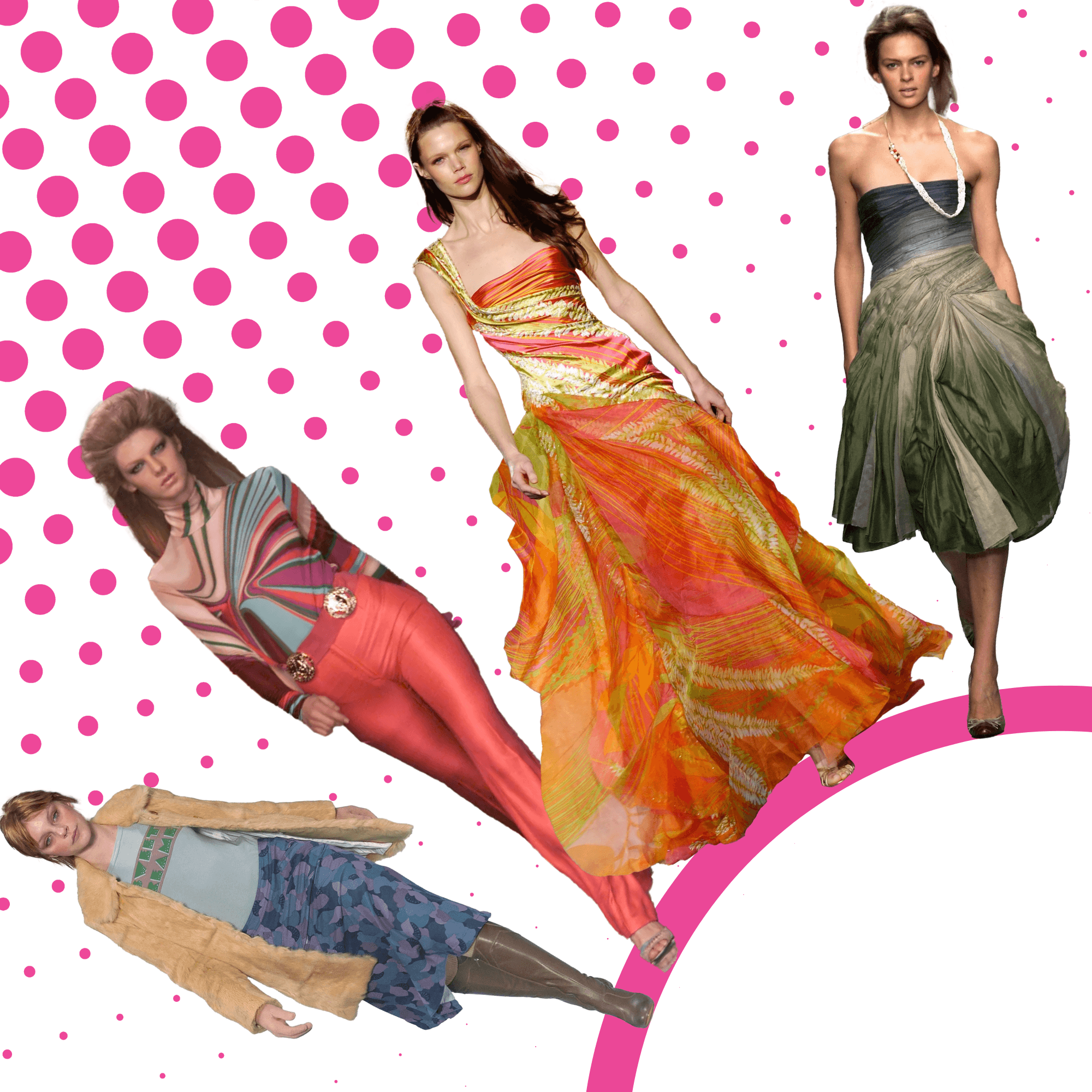
A defining runway moment of the early 2000s, Miuccia Prada’s spring 2000 collection captured the rise of playful femininity and nostalgic romanticism. The collection, a feminine rebellion at its core, paired delicate tones and dainty patterns with intentionally contrasting styling, helping spark the “grunge-pretty” aesthetic that shaped the decade. Prada’s enduring influence stems from her ability to make imperfection feel luxurious, blending irony, self-awareness and constant reinvention. The early 2000s runway was marked by excess and experimentation, when fashion leaned into glamour and self-expression. John Galliano brought theatrical storytelling and romantic chaos to the stage. Versace embraced metallics, plunging necklines and sculpted silhouettes. Blumarine turned sugary pastels, crystals and denim into Y2K icons. It was an era defined by confidence and contradiction, when fashion celebrated being unapologetically too much.
Trendsetters like Juicy Couture, Ed Hardy and Von Dutch defined the decade’s casual luxury. Mall staples such as Abercrombie & Fitch, Hollister and American Eagle shaped teen culture, making fashion an experience of scent, sound and status. Denim dominated the 2000s from low-rise jeans to bedazzled mini skirts, leaving everything a bit shiny, tight or intentionally too much. Pop stars and socialites became style leaders, with Paris Hilton’s pink velour tracksuits, Beyoncé’s crystal-studded denim and Britney Spears’ crop tops and accessories becoming pop-culture landmarks. Butterfly clips, platform flip-flops, mini handbags and oversized sunglasses completed the look. For many, fashion in the 2000s felt accessible, a mix of mall finds and Sharpie circles in fashion magazines. Streetwear began merging with high fashion as brands like Rocawear, Baby Phat and Sean John made hip-hop aesthetics mainstream, celebrating glamour and success in a bold new way.
This decade also marked the beginning of digital fashion. Paparazzi photos, celebrity candids and early online communities gave the public a view into the lives and closets of stars. It was no longer about fashion houses dictating trends from above; consumers now played a part in defining what was “in.” The idea of the influencer was born, years before Instagram made it official.
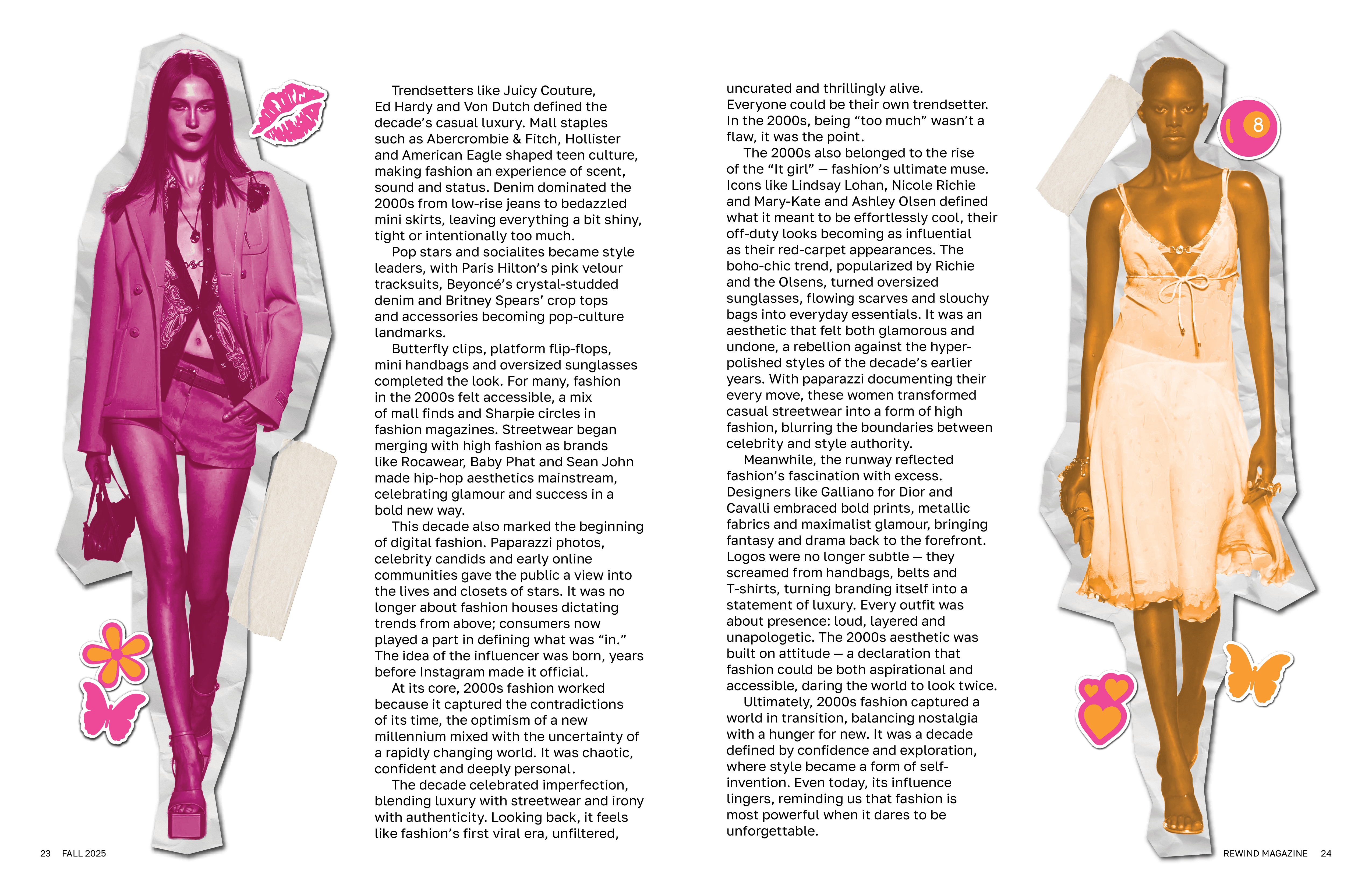
At its core, 2000s fashion worked because it captured the contradictions of its time, the optimism of a new millennium mixed with the uncertainty of a rapidly changing world. It was chaotic, confident and deeply personal. The decade celebrated imperfection, blending luxury with streetwear and irony with authenticity. Looking back, it feels like fashion’s first viral era, unfiltered, uncurated and thrillingly alive. Everyone could be their own trendsetter. In the 2000s, being “too much” wasn’t a flaw, it was the point. The 2000s also belonged to the rise of the “It girl” — fashion’s ultimate muse. Icons like Lindsay Lohan, Nicole Richie and Mary-Kate and Ashley Olsen defined what it meant to be effortlessly cool, their off-duty looks becoming as influential as their red-carpet appearances. The boho-chic trend, popularized by Richie and the Olsens, turned oversized sunglasses, flowing scarves and slouchy bags into everyday essentials. It was an aesthetic that felt both glamorous and undone, a rebellion against the hyper- polished styles of the decade’s earlier years. With paparazzi documenting their every move, these women transformed casual streetwear into a form of high fashion, blurring the boundaries between celebrity and style authority.
Meanwhile, the runway reflected fashion’s fascination with excess. Designers like Galliano for Dior and Cavalli embraced bold prints, metallic fabrics and maximalist glamour, bringing fantasy and drama back to the forefront. Logos were no longer subtle — they screamed from handbags, belts and T-shirts, turning branding itself into a statement of luxury. Every outfit was about presence: loud, layered and unapologetic. The 2000s aesthetic was built on attitude — a declaration that fashion could be both aspirational and accessible, daring the world to look twice.
Ultimately, 2000s fashion captured a world in transition, balancing nostalgia with a hunger for new. It was a decade defined by confidence and exploration, where style became a form of self- invention. Even today, its influence lingers, reminding us that fashion is most powerful when it dares to be unforgettable.
It-Girl Starter Pack
Before the days of Pinterest boards and TikTok outfit inspiration, fashion was discovered in a very different place… the mall. Girls flipped through Seventeen, shopped at Abercrombie and copied whatever their favorite Disney Channel star wore to a red carpet premiere. The early 2000s closet was a glitter- covered time capsule of confidence and chaos.
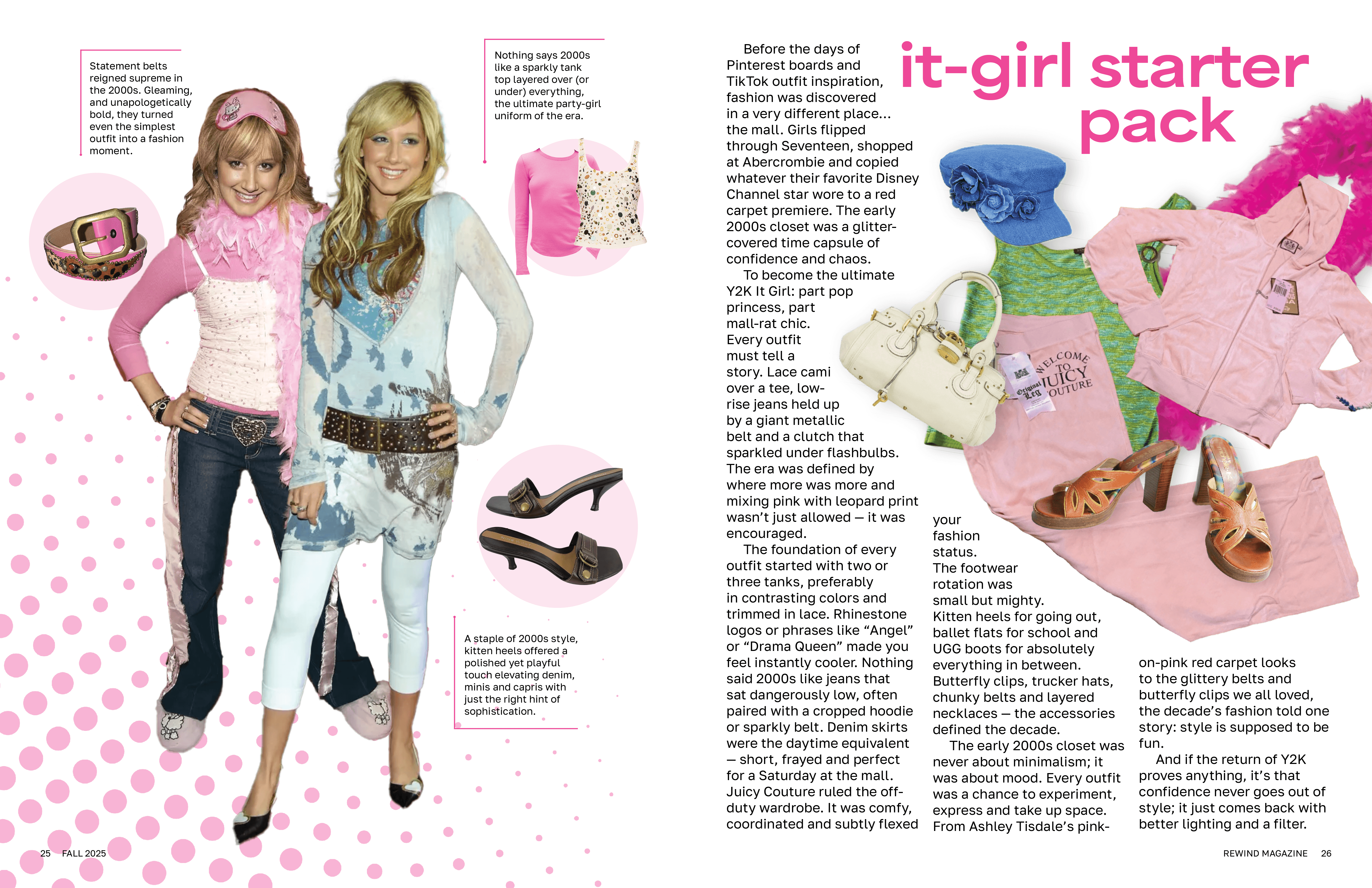
To become the ultimate Y2K It Girl: part pop princess, part mall-rat chic. Every outfit must tell a story. Lace cami over a tee, low-rise jeans held up by a giant metallic belt and a clutch that sparkled under flashbulbs. The era was defined by where more was more and mixing pink with leopard print wasn’t just allowed — it was encouraged. The foundation of every outfit started with two or three tanks, preferably in contrasting colors and trimmed in lace. Rhinestone logos or phrases like “Angel” or “Drama Queen” made you feel instantly cooler. Nothing said 2000s like jeans that sat dangerously low, often paired with a cropped hoodie or sparkly belt. Denim skirts were the daytime equivalent— short, frayed and perfect for a Saturday at the mall. Juicy Couture ruled the off- duty wardrobe. It was comfy, coordinated and subtly flexed your fashion status.
The footwear rotation was small but mighty. Kitten heels for going out, ballet flats for school and UGG boots for absolutely everything in between. Butterfly clips, trucker hats, chunky belts and layered necklaces — the accessories defined the decade. The early 2000s closet was never about minimalism; it was about mood. Every outfit was a chance to experiment, express and take up space. From Ashley Tisdale’s pink- on-pink red carpet looks to the glittery belts and butterfly clips we all loved, the decade’s fashion told one story: style is supposed to be fun. And if the return of Y2K proves anything, it’s that confidence never goes out of style; it just comes back with better lighting and a filter.
“What you wear is how you present yourself to the world, especially today when human contacts go so fast. Fashion is an instant language.” - Miuccia Prada, 2011
The Runway Edit
A defining runway moment of the early 2000s, Miuccia Prada’s spring 2000 collection captured the rise of playful femininity and nostalgic romanticism. The collection, a feminine rebellion at its core, paired delicate tones and dainty patterns with intentionally contrasting styling, helping spark the “grunge-pretty” aesthetic that shaped the decade. Prada’s enduring influence stems from her ability to make imperfection feel luxurious, blending irony, self-awareness and constant reinvention. The early 2000s runway was marked by excess and experimentation, when fashion leaned into glamour and self-expression. John Galliano brought theatrical storytelling and romantic chaos to the stage. Versace embraced metallics, plunging necklines and sculpted silhouettes. Blumarine turned sugary pastels, crystals and denim into Y2K icons. It was an era defined by confidence and contradiction, when fashion celebrated being unapologetically too much.
Trendsetters like Juicy Couture, Ed Hardy and Von Dutch defined the decade’s casual luxury. Mall staples such as Abercrombie & Fitch, Hollister and American Eagle shaped teen culture, making fashion an experience of scent, sound and status. Denim dominated the 2000s from low-rise jeans to bedazzled mini skirts, leaving everything a bit shiny, tight or intentionally too much. Pop stars and socialites became style leaders, with Paris Hilton’s pink velour tracksuits, Beyoncé’s crystal-studded denim and Britney Spears’ crop tops and accessories becoming pop-culture landmarks. Butterfly clips, platform flip-flops, mini handbags and oversized sunglasses completed the look. For many, fashion in the 2000s felt accessible, a mix of mall finds and Sharpie circles in fashion magazines. Streetwear began merging with high fashion as brands like Rocawear, Baby Phat and Sean John made hip-hop aesthetics mainstream, celebrating glamour and success in a bold new way.
This decade also marked the beginning of digital fashion. Paparazzi photos, celebrity candids and early online communities gave the public a view into the lives and closets of stars. It was no longer about fashion houses dictating trends from above; consumers now played a part in defining what was “in.” The idea of the influencer was born, years before Instagram made it official.
At its core, 2000s fashion worked because it captured the contradictions of its time, the optimism of a new millennium mixed with the uncertainty of a rapidly changing world. It was chaotic, confident and deeply personal. The decade celebrated imperfection, blending luxury with streetwear and irony with authenticity. Looking back, it feels like fashion’s first viral era, unfiltered, uncurated and thrillingly alive. Everyone could be their own trendsetter. In the 2000s, being “too much” wasn’t a flaw, it was the point. The 2000s also belonged to the rise of the “It girl” — fashion’s ultimate muse. Icons like Lindsay Lohan, Nicole Richie and Mary-Kate and Ashley Olsen defined what it meant to be effortlessly cool, their off-duty looks becoming as influential as their red-carpet appearances. The boho-chic trend, popularized by Richie and the Olsens, turned oversized sunglasses, flowing scarves and slouchy bags into everyday essentials. It was an aesthetic that felt both glamorous and undone, a rebellion against the hyper- polished styles of the decade’s earlier years. With paparazzi documenting their every move, these women transformed casual streetwear into a form of high fashion, blurring the boundaries between celebrity and style authority.
Meanwhile, the runway reflected fashion’s fascination with excess. Designers like Galliano for Dior and Cavalli embraced bold prints, metallic fabrics and maximalist glamour, bringing fantasy and drama back to the forefront. Logos were no longer subtle — they screamed from handbags, belts and T-shirts, turning branding itself into a statement of luxury. Every outfit was about presence: loud, layered and unapologetic. The 2000s aesthetic was built on attitude — a declaration that fashion could be both aspirational and accessible, daring the world to look twice.
Ultimately, 2000s fashion captured a world in transition, balancing nostalgia with a hunger for new. It was a decade defined by confidence and exploration, where style became a form of self- invention. Even today, its influence lingers, reminding us that fashion is most powerful when it dares to be unforgettable.
It-Girl Starter Pack
Before the days of Pinterest boards and TikTok outfit inspiration, fashion was discovered in a very different place… the mall. Girls flipped through Seventeen, shopped at Abercrombie and copied whatever their favorite Disney Channel star wore to a red carpet premiere. The early 2000s closet was a glitter- covered time capsule of confidence and chaos.
To become the ultimate Y2K It Girl: part pop princess, part mall-rat chic. Every outfit must tell a story. Lace cami over a tee, low-rise jeans held up by a giant metallic belt and a clutch that sparkled under flashbulbs. The era was defined by where more was more and mixing pink with leopard print wasn’t just allowed — it was encouraged. The foundation of every outfit started with two or three tanks, preferably in contrasting colors and trimmed in lace. Rhinestone logos or phrases like “Angel” or “Drama Queen” made you feel instantly cooler. Nothing said 2000s like jeans that sat dangerously low, often paired with a cropped hoodie or sparkly belt. Denim skirts were the daytime equivalent— short, frayed and perfect for a Saturday at the mall. Juicy Couture ruled the off- duty wardrobe. It was comfy, coordinated and subtly flexed your fashion status.
The footwear rotation was small but mighty. Kitten heels for going out, ballet flats for school and UGG boots for absolutely everything in between. Butterfly clips, trucker hats, chunky belts and layered necklaces — the accessories defined the decade. The early 2000s closet was never about minimalism; it was about mood. Every outfit was a chance to experiment, express and take up space. From Ashley Tisdale’s pink- on-pink red carpet looks to the glittery belts and butterfly clips we all loved, the decade’s fashion told one story: style is supposed to be fun. And if the return of Y2K proves anything, it’s that confidence never goes out of style; it just comes back with better lighting and a filter.